Why are some people more at risk than others? Why aren’t near misses getting reported? Why does safety performance vary so dramatically from one team to the next?
Without answers to those questions, the standard responses — more training, more audits, more reminders — can actually make things worse. They create the conditions for issues to fester, not fix them.
The OSE is a deep, structured diagnostic of your organisation’s safety culture, built around the one source of insight most evaluations miss: what your people actually think, say and experience at work.
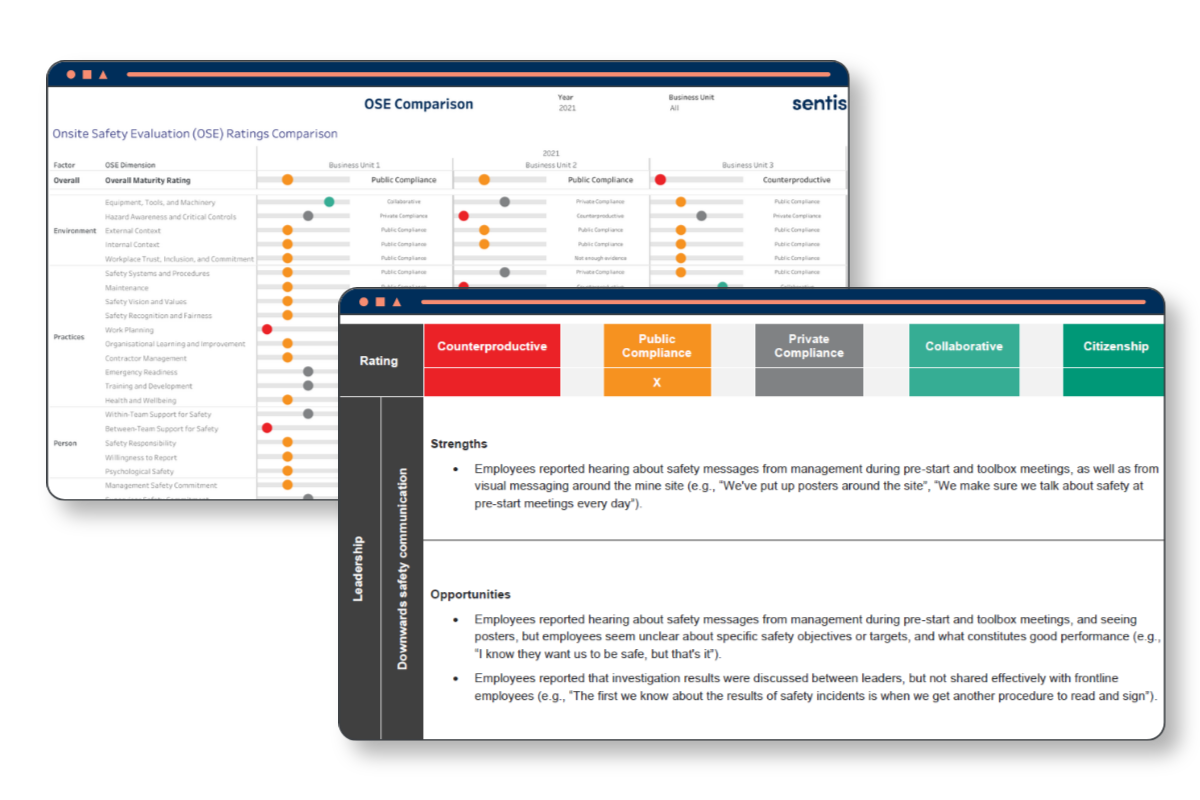
Our team conducts interviews and focus groups — onsite, online, or both — with leaders, supervisors and frontline teams. We observe the work environment and how work actually happens. Then we do something most providers can’t: we analyse thousands of your people’s own statements across 24 dimensions of safety culture, and benchmark your culture against our safety culture maturity model.
The result isn’t a list of observations. It’s a clear, calibrated picture of where your culture actually sits — and what’s driving it.
We spend time with your people — typically 2–4 days, with coverage across around 15% of your site or workforce. For larger or more complex operations, we extend to match.
This includes:
Every session is designed to create the conditions for honest conversation. We’re not there to audit — we’re there to understand. Interviews and focus groups can be delivered onsite or online, designed around what works for your operation.
Every conversation generates data. Across a typical evaluation, we capture 6,000 to 10,000 individual statements from your workforce.
Our research team codes and categorises every one of them against 24 dimensions of safety culture, then performs a rigorous thematic analysis. The consistent themes, tensions and patterns that emerge don’t just tell us what people said — they tell us what the collective story means for how safety culture is being experienced across roles, teams and levels.
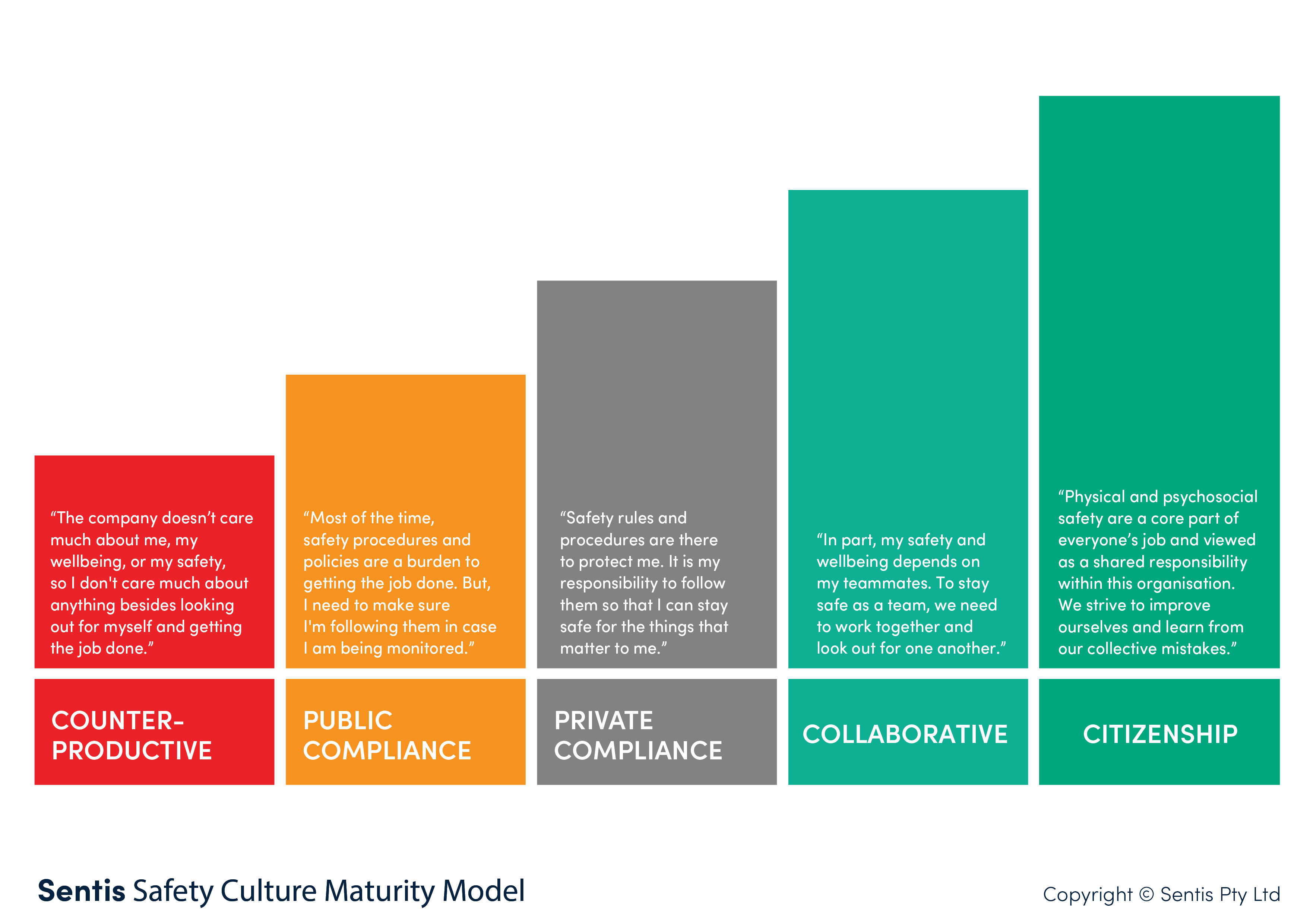
Each of the 24 dimensions is then rated against our safety culture maturity model.
This isn’t a quick scoring exercise. Our team reviews the evidence for each dimension and benchmarks it against detailed maturity descriptors — from early-stage compliance cultures through to self-sustaining, values-driven safety cultures. Ratings are debated and confirmed in structured calibration sessions, so every result is defensible and consistent.
The standard is the same every time, for every organisation. Which means your results are comparable across sites, over time, and against a clear framework for what mature safety culture looks like.
The methodology has been recognised by the Society for Industrial and Organizational Psychology (SIOP) — the global peak body for the science of workplace psychology.
Selected from over 1,400 submissions, our paper Applying Industrial/Organisational Science and Methods to Diagnose Safety Culture Maturity was peer-reviewed by international experts in 2013 and commended for its contribution to the field.
"Provides a blueprint for developing theory-based models and measurement methodology."
SIOP Peer Reviewer
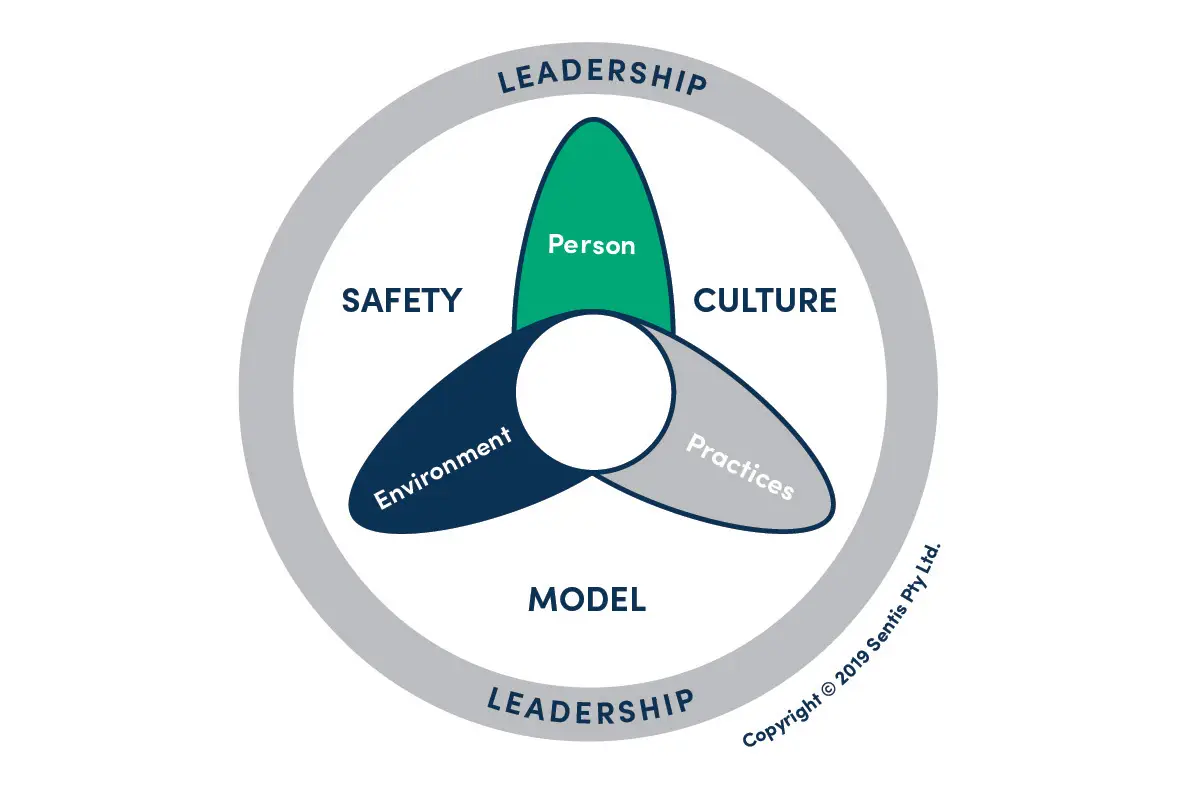
The OSE examines your safety culture across 24 dimensions, grouped within our safety culture model. Together they cover the person, environment and practices that shape how safety is experienced, and the leadership that influences all three.
Explore the model to see exactly what we measure.
Every dimension receives a maturity rating, placing your organisation on a scale from counterproductive through to citizenship. Five distinct stages, each with its own pattern of attitudes, behaviours and beliefs.
Knowing exactly where you are, and what’s keeping you there, is where real change begins.
It’s a benchmark you can act on and track over time.
You’ll understand where your safety culture sits on a clear maturity scale — and what’s actually driving it. Not assumptions, not hunches, not what people report in a survey. The real attitudes, beliefs and pressures shaping safety decisions every day, drawn directly from the people living it.
That clarity changes the conversation. Leaders stop debating what the problem might be and start aligning on where to focus.
Common scenarios include:
Delivered onsite, online, or a combination — designed around what works for your operation.Â
The survey tells you what your people perceive across your broader workforce. The OSE tells you why, through direct conversations with a representative cross-section of your organisation. Together they form the Positive Safety Benchmark: Explorer, giving leaders both the breadth and depth to make confident decisions about safety culture.