
Pre-starts, toolbox talks and pre-shift meetings are routine across many industries. They bring teams together before work begins, creating a moment to focus attention, align expectations and discuss safety and performance.
For leaders, these conversations happen in busy, high-pressure environments. Time is limited, production demands are high, and teams are often distracted while leaders juggle multiple priorities.
It’s understandable that pre-starts don’t always land as intended.
Yet research and experience show that these short, regular conversations can strongly influence how people think about risk, how teams work together, and how safety is experienced day to day.
When used well, pre-starts become more than a routine discussion, they become a meaningful moment of connection and clarity for the team.
Why pre-starts matter for safety culture
From a human factors and learning perspective, pre-starts sit in a uniquely influential position in the working day. They happen in the flow of work, just before tasks begin, where teams are together in a social setting in a repetitive, daily manner.
These conditions set pre-starts up to be powerful safety drivers, as research into attention and learning shows that people absorb information best when it is:
- Relevant to what they are about to do
- Short and focused
- Discussed rather than simply delivered
- Connected to real experience
Social science also tells us that what leaders model in everyday interactions strongly shapes norms and expectations. Over time, repeated conversations send signals about what matters, what is acceptable, and whether it is safe to speak up.
In other words, pre-starts help shape the safety experience as a whole—not through policies or procedures, but through daily human interaction.
The reality leaders face on the frontline
For many leaders, pre-starts happen in fast-moving environments where time is tight and work is complex. Conversations often take place in noisy settings where distractions are common and energy levels vary day to day.
At the same time, leaders are expected to cover operational updates, confirm tasks, discuss hazards and keep the meeting brief. It’s a demanding role.
Over time, it’s easy for pre-starts to slip into routine, repeating the same structure, messages and script, and that doesn’t reflect a lack of care or commitment. Most leaders want these conversations to matter. The challenge is that many are expected to run influential safety conversations without much guidance on how to do that well.
Improving pre-starts isn’t about adding more to your workload. It’s about making the most of the short window you already have with your team.
How small changes improve pre-start conversations
When pre-starts are working well, the difference is often subtle but powerful.
Rather than simply delivering information, strong pre-starts create a short conversation that connects the team to the work ahead. Leaders draw attention to today’s risks, invite input from the group and reinforce shared expectations about how the team will operate.
A helpful way to think about this shift is in terms of strengthened practice:
Traditional Focus
- Sharing information
- Covering hazards
- Leader speaking
- Same format each day
- Compliance-driven
Strengthened Approach
- Creating conversation
- Exploring today's risks
- Team contribution
- Adapted to the work
- Engagement-driven
These changes don’t require longer meetings or complex redesigns. Often they come from small adjustments in how leaders guide the conversation and invite participation.
Over time, those everyday conversations shape how teams experience safety. People stay more focused on risks, feel more comfortable sharing concerns and learn from each other’s experiences. Safety becomes less about compliance and more about how work is done together.
By strengthening an existing moment in the working day, organisations can create a ripple effect across safety, wellbeing and performance — without adding burden to leaders or teams.
Practical support for running better pre-starts
Understanding what makes pre-starts effective is one thing. Turning that knowledge into something usable for busy leaders is another. This is where many organisations encounter a gap.
To help bridge this gap, we developed the Pre-Starts Field Kit — a practical resource designed to support leaders in running focused, engaging and relevant pre-start conversations in real-world conditions.
The Field Kit is built around three core needs:
Structure
Supports leaders to facilitate and guide conversations with clarity.
Safety Prompts
101 ready-to-use prompts encouraging participation and shared thinking.
Simplicity
Used quickly and easily in the field, without adding to busy workloads.
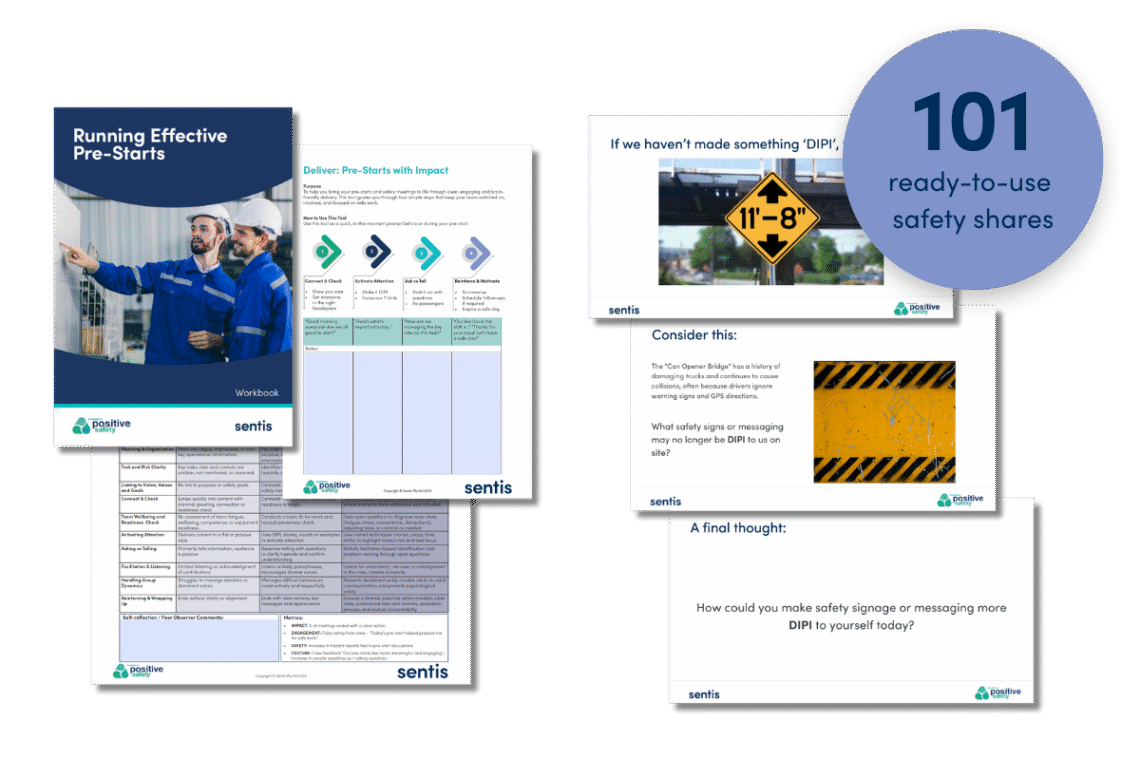
Rather than scripts, the Field Kit provides conversation starters and guiding questions that help leaders focus on what matters today, invite team input and keep discussions short and purposeful.
Importantly, it works with existing pre-starts rather than replacing them.
Supporting leaders where they are
Pre-starts are not a silver bullet. But they are one of the few moments where leaders and teams pause together before work begins. That makes them a powerful opportunity.
Recognising the challenges leaders face, and providing tools that work within those constraints, is key to making that opportunity count.
For organisations looking to lift the quality of pre-starts without introducing another program, practical tools like the Pre-Starts Field Kit can help turn everyday conversations into meaningful moments of alignment, learning and connection.
Better pre-starts. Better conversations. Better outcomes.
Curious about what more effective pre-starts could look like in your organisation? Get in touch with our team to start the conversation.