

From Safety Review to Lasting Culture Change
How a 4-year partnership reduced serious injury potential by a third, and shifted a whole workforce's relationship with safety
- Industry: Mining & Resources
- Region: Regional Queensland, Australia
- Workforce: ~180 employees and contractors
Client Snapshot
A bulk commodity export terminal operating in regional Queensland with a workforce of around 180 employees and contractors. Running complex, high-consequence operations around the clock, the organisation holds safety performance to a world-class standard, and recognised it needed to go further.
33.7%
Reduction in serious injury & fatality potential (SIFp) exposure
2x
Increase in hazard reporting since 2019
8 of 8
Safety leadership competencies improved
Objective
A safety culture review had identified several focus areas. Attitudes and behaviours weren’t fully aligned. Engagement with critical risk controls was uneven across the workforce, and leaders lacked a consistent language to drive meaningful safety conversations.
The organisation sought a partner who could shift safety mindsets, build leadership capability at every level, strengthen critical risk management, and embed these practices into daily work, not just the training room.
Solution
Diagnostics & Insight
Validated Safety Climate Surveys and pulse diagnostics tracked perceptions of leadership, communication and error management across 2021-2024, providing real data to guide the programme.
Safety Leadership Development
Training, coaching and structured safety interactions lifted capability from frontline leaders through to senior management, assessed across eight competencies.
Critical Risk Management
Team programs, infield verification coaching and e-learning deepened engagement with Critical Control Verification (CCV), building both confidence and consistency in practice.
Whole-Person Safety
A Psychosocial Risk Assessment using surveys and focus groups broadened the safety lens. understanding exposure to psychosocial hazards as part of a holistic Positive Safety approach.
Progress you can measure
Since partnering with Sentis, every dimension of safety culture shifted, from how leaders show up to how the workforce thinks about risk.
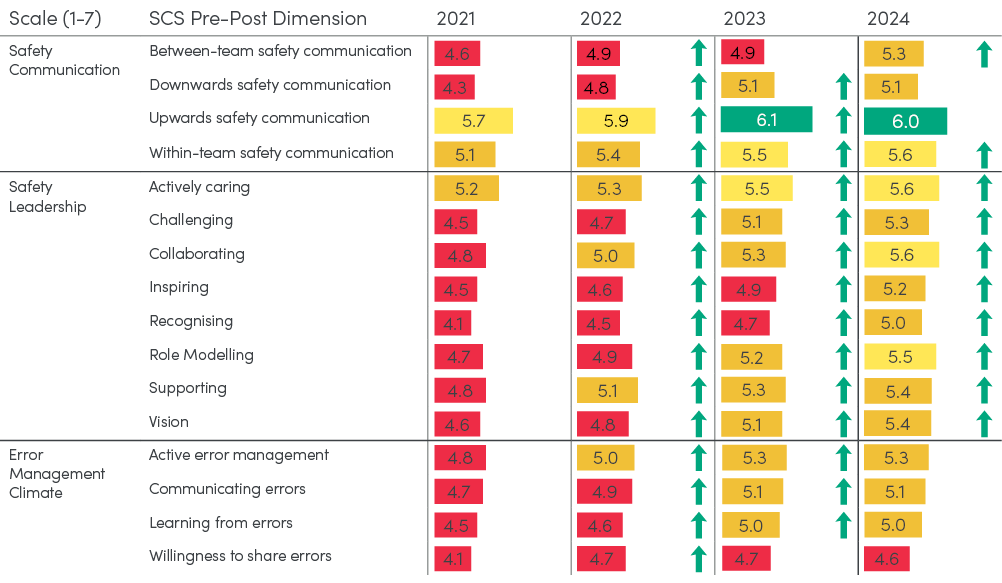
Scores are on a 1–7 scale. Red indicates a negative safety climate (below 5.0), amber a fair climate (5.0–5.9), and green a positive climate (6.0+). Arrows show year-on-year improvement.
SIFp exposure declining
Serious injury and fatality potential fell from 16.3% in 2019 to 10.8% by 2023 — a meaningful reduction in catastrophic risk exposure.
Hazard reporting rising
Consistent year-on-year increase signals greater workforce trust, awareness and proactive risk identification.
CCV confidence lifted
Leaders reported stronger confidence and consistency in conducting Critical Control Verifications in the field.
What shifted on the ground
One of the most significant shifts was the development of a common safety language across all levels of the workforce. Safety conversations became more consistent, more honest and more action-oriented, moving from compliance to genuine engagement.
Communication
Between-team and upward safety communication improved significantly across the measurement period.
Error Management
Willingness to share and learn from errors increased — a key marker of psychological safety.
Leadership Visibility
Leaders became more active in role modelling, recognising safe behaviour and challenging risk.
What the data doesn't show is the shift in how people talk about safety day-to-day. That change in language — from compliance to genuine engagement — is often where lasting culture change begins.
Ready to Shift Your Culture?
Explore how our Driving Positive Safety approach can help you build leadership capability, strengthen critical risk management, and create a culture where safety sticks.
Contact us