If you’ve ever asked what is safety culture, and why some workplaces stay safe while others keep having the same incidents, you’re asking the right question. Safety culture is the shared set of values, beliefs and behaviours that shape how people approach safety every day, especially when no one’s watching. It’s the difference between following a procedure because the rules say so, and following it because everyone understands why it matters.
The term gained traction after the 1986 Chernobyl disaster, when investigators looked past the broken equipment and found a deeper problem in how the organisation thought and behaved. Decades on, the lesson holds. Systems and procedures matter, but they only work as well as the culture they sit inside.
What safety culture actually means
Here’s a plain safety culture definition: it’s how your people genuinely think, feel and act about safety when the auditor has gone home and the deadline is looming.
Strong cultures show up in small moments. A crew member stops a job because something feels off. A supervisor asks a real question instead of ticking a box. A new starter feels safe enough to admit they don’t understand a task.
Culture isn’t your safety manual, your signage or your lost-time injury rate. Those are outputs. Culture is the invisible operating system underneath them, quietly deciding what people prioritise when speed, cost and safety pull in different directions.
That’s why two sites with identical procedures can perform so differently. The paperwork looks the same. The mindset behind it doesn’t.
Culture isn’t your safety manual, your signage or your lost-time injury rate. Those are outputs.
Why safety culture matters
The business case for a strong safety culture goes well beyond avoiding harm, though it certainly does that too.
In a strong culture, people report near-misses early, so small problems get fixed before they become serious ones. Hazards surface quickly. Lessons travel across teams. Leaders make better decisions because they’re working with honest information rather than a sanitised version.
The flow-on effects reach the whole operation. Workplaces with healthy safety cultures tend to see better retention, higher engagement and more discretionary effort. People who feel genuinely cared for bring more of themselves to work. Safety and performance rise together, not at each other’s expense. That idea sits at the heart of Sentis’ Positive Safety philosophy: safety is about improving quality of life, not just reducing harm.
A weak culture quietly works against you. Risks get normalised. Shortcuts become the unofficial standard. People stop reporting because nothing changes, or because speaking up feels unsafe. The numbers can look fine right up until a serious incident exposes what everyone already knew.
That gap between the reported picture and the lived reality is where the real danger hides. A strong culture closes it.
Picture two crews running the same task. On the first, a worker spots a frayed sling, flags it and the job pauses for two minutes while it’s swapped. On the second, the same worker notices the same sling, says nothing because the last person who raised an issue got an earful, and the lift goes ahead. Same equipment, same procedure, two very different outcomes. The only variable is culture.
Safety culture vs safety climate
People often use these terms interchangeably, but the distinction is practical and worth getting right. Here’s how safety culture and safety climate compare:
| Safety Culture | Safety Climate | |
|---|---|---|
| Definition | The deep, enduring layer: the shared values, beliefs and assumptions that reflect how the organisation really operates. | The surface layer: how people perceive safety right now, including current mood, attitudes and confidence in leadership. |
| Timeframe | Long-term, built over years. | Short-term, a snapshot of the present moment. |
| Rate of change | Changes slowly and is deeply embedded. | Shifts more quickly in response to recent events. |
| How it’s measured | Harder to measure directly; inferred over time through behaviour and patterns. | Easier to measure directly via a well-designed perception survey, such as Sentis’ Safety Climate Surveys. |
| Example | The season — what you can expect over time. | The weather — what’s happening today, after a new leader, a recent incident or a fresh initiative. |
Think of climate as the weather and culture as the season: the weather tells you what’s happening today, while the season tells you what to expect over time.
What a strong safety culture looks like in practice
Forget the theory for a moment. Here are real, observable safety culture examples you can look for on any site.
People speak up without fear. A worker challenges an unsafe instruction, and the response is curiosity rather than defensiveness. Near-misses get reported openly, because everyone knows reporting leads to learning, not blame.
Leaders show up and ask genuine questions. They spend time where the work happens. They listen more than they instruct. When they talk about safety, it lines up with the decisions they actually make, including the hard ones about budget and time.
Safety lives inside the work, not beside it. It isn’t a separate task bolted onto the real job. It’s woven into how people plan, communicate and make calls under pressure.
Peers look out for each other. Someone notices a colleague is fatigued, distracted or rushing, and they step in. The social norm is care, not “mind your own business.”
These signals reveal far more than any single metric. Leadership behaviour, in particular, sets the tone for everything else. That’s why Safety Leadership is so often the lever that shifts a whole culture.
Common barriers to a strong safety culture
Most organisations want a better safety culture. The barriers are usually predictable, and recognising them is the first move toward clearing them.
A blame culture is the big one. When mistakes lead to punishment rather than learning, people stop reporting. Information dries up, and leaders lose sight of the real risks.
Leadership lip service is another. When leaders say safety is the priority but reward speed and output above all, people read the real message clearly. Actions always speak louder than posters.
A compliance-only mindset caps how far you can go. Ticking boxes keeps you legal, but it doesn’t build the judgement and ownership that keep people safe in genuinely unpredictable conditions.
Change fatigue wears teams down. After enough short-lived initiatives, people learn to wait out the latest programme rather than commit to it.
Finally, many organisations still overlook psychosocial risk. Stress, fatigue, bullying and poor job design erode safety as surely as any physical hazard. Treating mental health as part of safety, not a separate conversation, is now essential. Sentis’ work in Psychosocial Safety helps organisations meet that challenge head-on.
How to improve safety culture
So how do you improve safety culture in a way that actually sticks? Sentis’ Driving Positive Safety framework gives you four interconnected areas of focus: Understand, Align, Implement and Integrate. These aren’t a checklist to tick off in order. They’re dimensions of culture change that reinforce one another and run in parallel.
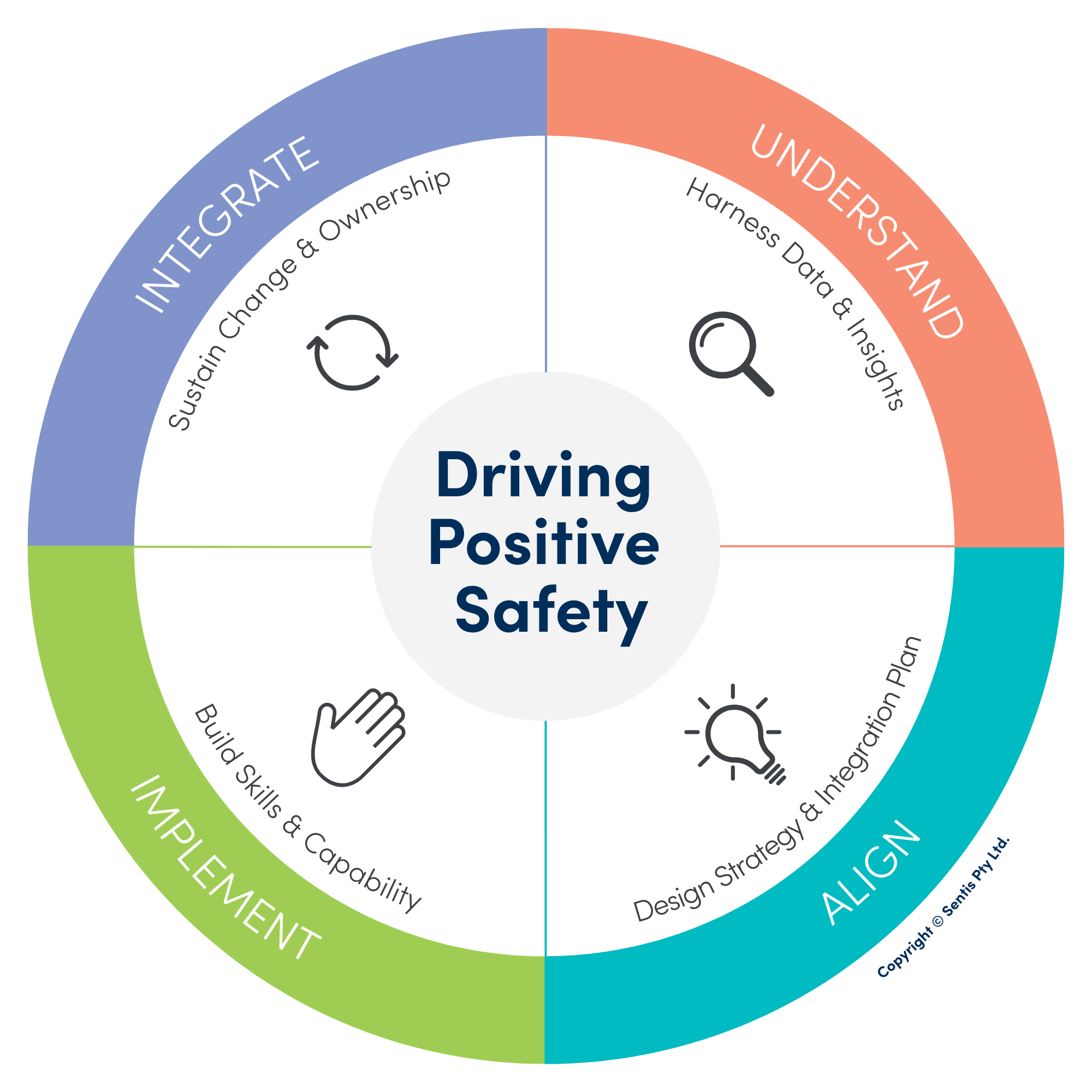
Understand
You can’t shift what you haven’t honestly diagnosed. Start by getting a clear picture of your current culture, the mindsets driving behaviour and the gaps between intention and reality. Good data here prevents you from solving the wrong problem.
Align
Culture follows leadership. This focus is about getting leaders genuinely on the same page, connecting safety to a shared purpose and making sure what leaders say matches what they reward. When alignment is real, the rest gets far easier.
Implement
This is where capability gets built. People learn the skills, mindsets and behaviours that make safety part of how they work. Practical tools, coaching and conversations turn good intentions into daily habits.
Integrate
A culture only lasts when it’s embedded into the systems people use anyway, like recruitment, onboarding, recognition and decision-making. Integration is what stops a strong culture from quietly fading once the initial energy passes.
The reason these four work together rather than in sequence is simple. You keep building understanding as you go. You keep realigning leaders as conditions change. Culture change isn’t a project with an end date. It’s a way of operating you keep strengthening.
How to measure safety culture
You can’t manage what you don’t measure, and culture is no exception. The good news is that culture leaves plenty of measurable traces.
Lagging indicators, like injury and incident rates, tell you what’s already happened. They matter, but they’re a rear-view mirror. By the time they move, the underlying issue has been present for a while.
Leading indicators give you a forward view. Reporting rates, the quality of safety conversations, hazard close-out times and participation in safety activities all signal where your culture is heading before incidents occur.
Perception surveys add the human layer. A robust safety climate survey reveals what people actually believe about leadership, reporting and whether speaking up is safe. Pair that with behavioural observation and honest conversations on the ground, and you get a rounded picture.
The aim isn’t a single score. It’s a clear, repeatable read on your current state that shows whether the changes you’re making are working.
Cadence matters too. Measuring once tells you where you stand. Measuring at regular intervals tells you whether you’re moving, and in which direction. Tracking the same indicators over time turns a one-off snapshot into a trend you can actually steer. It also keeps leaders accountable, because progress becomes visible rather than assumed.
Where to go from here
Understanding what safety culture is matters. Doing something deliberate about it is what changes outcomes.
For more than 20 years, Sentis has helped over 500 organisations across 35 countries build safer, higher-performing cultures, with deep experience in mining, utilities and agriculture. Our psychology-based approach focuses on the mindsets and behaviours that drive lasting change, not quick fixes that fade.
A sensible next step is to find out where your culture stands today. A safety culture assessment gives you an honest baseline and a clear view of your biggest opportunities. From there, targeted leadership development, training and consulting help you turn insight into real, measurable progress.
Frequently asked questions
What is safety culture?
What is safety culture?
Safety culture is the shared set of values, beliefs and behaviours that shape how people approach safety every day. It’s how your people genuinely think and act about safety when no one’s checking, and it sits beneath your procedures, signage and metrics.
Why is safety culture important?
Why is safety culture important?
A strong safety culture reduces incidents and does much more besides. People report risks early, leaders make better-informed decisions and engagement improves. Safety and performance rise together. A weak culture normalises risk and hides problems until they become serious.
What is the difference between safety culture and safety climate?
What is the difference between safety culture and safety climate?
Safety culture is the deep, enduring layer of shared values, built over years and slow to change. Safety climate is the surface layer, capturing how people perceive safety right now. Think of climate as the weather and culture as the season.
How do you measure safety culture?
How do you measure safety culture?
Combine three views. Lagging indicators, like incident rates, show what’s already happened. Leading indicators, like reporting rates and hazard close-out times, signal where you’re heading. Perception surveys reveal what people actually believe, giving you a forward-looking read.
How do you improve safety culture?
How do you improve safety culture?
Start by honestly understanding your current culture, then align leaders around a shared purpose, build capability through practical skills and behaviours, and embed safety into everyday systems. These work together rather than in strict sequence, and culture change is ongoing rather than a one-off project.